Software companies rely on data more than almost any other industry.
You track product usage.
You analyze MRR and churn.
You optimize acquisition channels.
You monitor lifecycle stages.
But here’s the uncomfortable question: Is your HubSpot CRM structured to support how your software business actually sells, reports, and scales?
In many cases, it isn’t. That’s where a focused HubSpot CRM audit for software companies creates immediate impact.
Why Software Companies Outgrow Their CRM Setup
HubSpot CRM setups rarely scale with the business
Most SaaS and software companies start fast. HubSpot is implemented quickly. Sales pipelines are created early. Properties are added on demand. Workflows are built reactively. Then the company scales.
You introduce:
- Multiple ICPs
- Product tiers
- Trials and freemium flows
- Account-based sales
- Partnerships
- Customer success expansion
- Multi-region sales teams
But the CRM structure often stays largely the same. And that’s when problems start.
What We Typically See in Software Companies
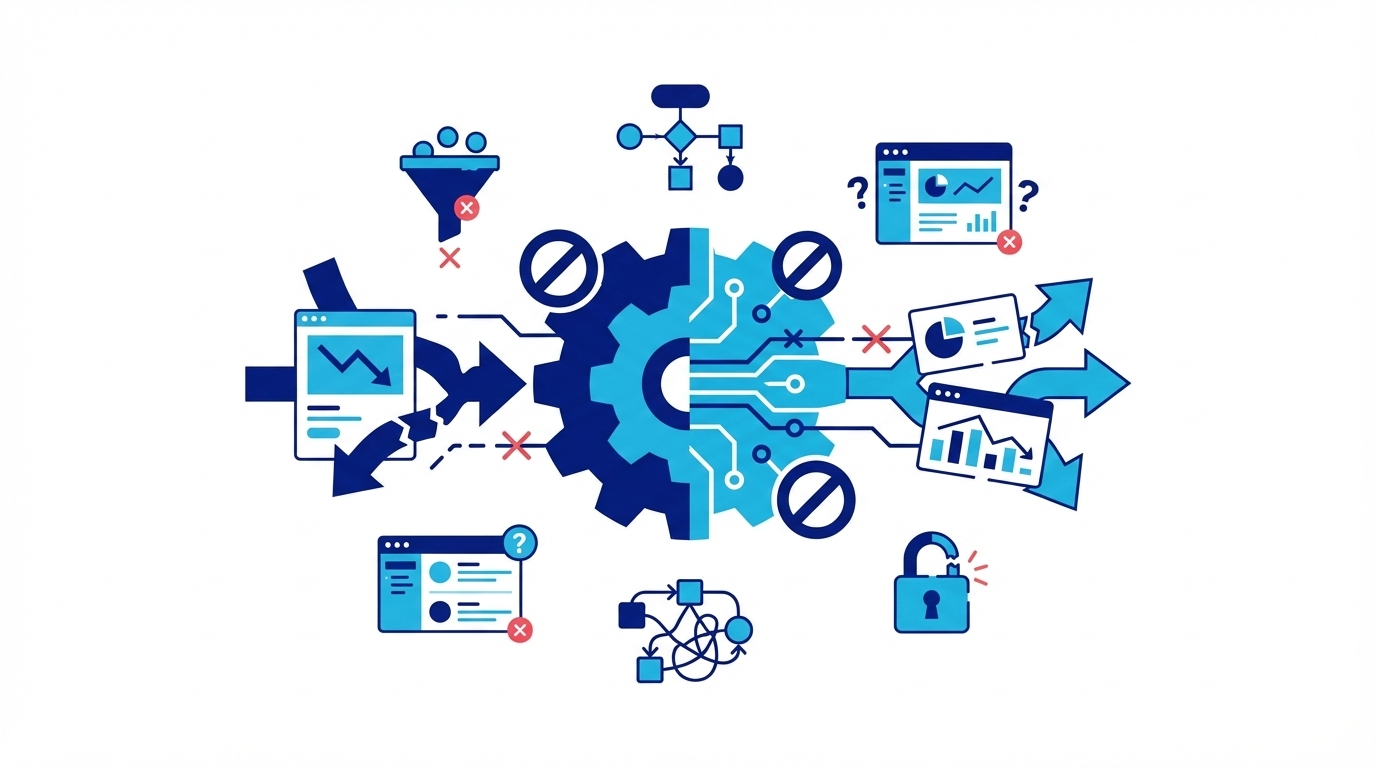
During a SaaS CRM audit, we frequently uncover:
- Deal stages that don’t match the real buying journey
- No clear separation between MQLs and product-qualified leads (PQLs)
- Inconsistent lifecycle stage logic
- Manual handovers between marketing, sales, and customer success
- Revenue tracking not fully aligned with subscription models
- Overcomplicated workflows no one wants to modify
- Reports that don’t accurately reflect MRR, ARR, churn, or expansion revenue
The result?
Leadership lacks revenue clarity. Sales loses time. RevOps works around the system instead of improving it. Scaling becomes harder than it should be.
How the HubSpot CRM Audit Works
(For Software Businesses)
This is not a theoretical review.
It’s a structured, business-focused assessment designed around how software companies actually operate.
Step 1: CRM Structure & Data Model Review
We analyze:
- Object structure (Contacts, Companies, Deals, and Custom Objects where applicable)
- Subscription and revenue tracking setup (including property logic and integrations)
- Property duplication and governance
- Data consistency and hygiene
- Lifecycle stage alignment
Goal: Ensure your HubSpot CRM setup reflects your SaaS revenue model and customer lifecycle.
Step 2: Sales Pipeline & Process Evaluation
We review:
- Pipeline structure vs. real sales behavior
- Trial → Demo → Proposal → Closed logic
- Enterprise vs. SMB pipeline separation
- Deal probability accuracy
- Automation between stages
Goal: Align CRM stages with actual buyer behavior and revenue forecasting needs.
Step 3: Workflow & Automation Review (Up to 10 Key Workflows)
We evaluate:
- Lead routing logic
- Trial onboarding automation
- PQL triggers and alerts
- Sales notifications
- Internal task automation
- Customer success handoffs
We also assess HubSpot AI and predictive features currently available in your portal.
Goal: Reduce manual friction and improve operational scalability.
Step 4: Reporting & Revenue Visibility
We assess:
- MRR / ARR tracking logic inside HubSpot
- Churn and expansion visibility
- Forecast reliability
- Executive dashboards
- Attribution setup
Goal: Provide leadership with accurate, decision-ready revenue insights.
This process often becomes the foundation for long-term HubSpot CRM optimization for SaaS companies.
What You Get After the Audit
You receive clear, structured output:
- A list of critical CRM bottlenecks
- A prioritized roadmap (quick wins vs. structural improvements)
- Revenue-impacting issues highlighted first
- Automation and AI improvement recommendations
- Data cleanup and governance strategy
- Clear next steps — with no obligation to continue with implementation services
The result is a practical action plan you can implement internally or with support.
When a Software Company Should Consider
a CRM Audit
A HubSpot CRM audit for software companies is especially valuable if:
- You’ve scaled from startup to growth stage
- Sales, marketing, and customer success operate in silos
- Reporting feels unreliable or inconsistent
- Your RevOps team spends more time fixing data than analyzing it
- You’re preparing for funding, scaling, or restructuring
At this stage, a clean and scalable CRM structure becomes critical.
Turn HubSpot Into Growth Infrastructure —
Not Just a Database
HubSpot is powerful. But for software companies, it must:
- Reflect subscription economics
- Support complex buyer journeys
- Connect product and CRM data (via proper integration strategy)
- Provide reliable revenue reporting
- Enable scalable automation
Otherwise, it becomes a hidden friction point.
Ready to See What’s Holding Your HubSpot Back?
If you’re a software company using HubSpot CRM and want clarity on whether your setup supports your next growth stage — let’s talk.
We’ll start with a short intro call to understand your current structure and explain how a SaaS-focused CRM audit works.