Enterprise sales are complex by design: long buying cycles, multiple stakeholders, custom pricing, account-based strategies, board-level forecasting pressure.
HubSpot is fully capable of supporting this complexity — when properly structured and aligned with enterprise sales processes.
In many enterprise B2B companies, the CRM was implemented years ago and gradually expanded. New properties were added. Pipelines multiplied. Workflows accumulated.
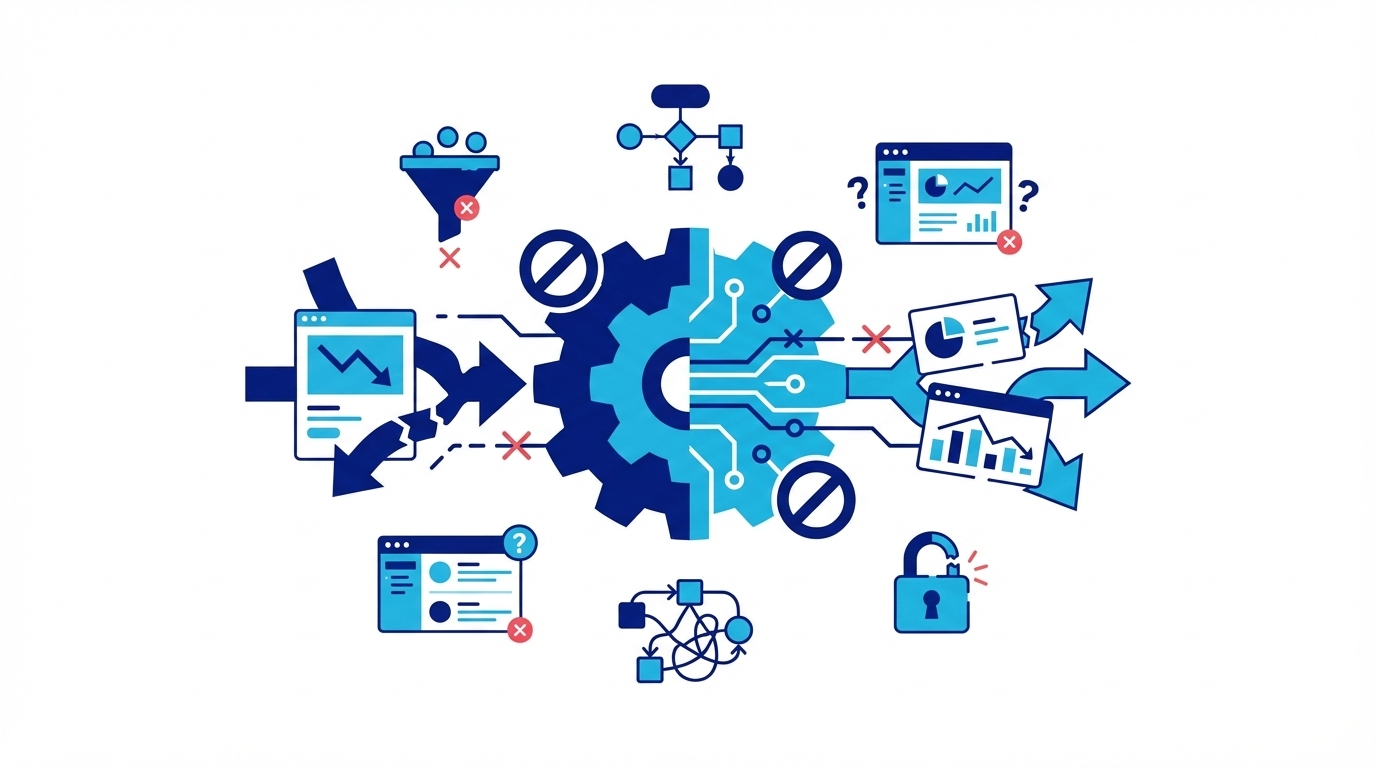
At some point, the system stops accelerating growth — and starts slowing it down.
Below are seven clear signs your HubSpot CRM may be limiting enterprise sales performance.
1. Your Deal Stages Don’t Reflect the Real Buying Process
Enterprise sales rarely move in straight lines. If your pipeline stages look clean on paper but sales reps frequently work around them, that’s a red flag.
Common issues include:
- Stages that don’t reflect buying committees
- No clear differentiation between technical validation and commercial negotiation
- Oversimplified probability logic
- Multiple meaningful steps happening inside a single stage
When pipeline structure doesn’t mirror reality, forecasting and reporting lose reliability.
HubSpot forecasting depends on structured deal stages, probability settings, and forecast categories. If those don’t reflect real behavior, visibility suffers.
2. Forecasting Requires Constant Manual Adjustments
If your revenue forecast depends on:
- Spreadsheet corrections
- Manual probability overrides
- End-of-quarter CRM cleanups
- Manager “gut-feel” adjustments
Then your CRM structure likely isn’t aligned with how enterprise deals actually progress.
HubSpot supports weighted pipelines and forecast categories — but those only work when deal stage logic and probability definitions are clearly governed.
Enterprise organizations need structured forecasting logic, not reactive corrections.
3. Enterprise and Mid-Market Sales Are Structured the Same Way
Enterprise deals behave differently from mid-market or SMB sales.
If both segments share:
- The same pipeline
- The same deal stages
- The same automation logic
- The same reporting views
You likely lack segmentation clarity.
HubSpot allows multiple pipelines and structured segmentation — but without clear design, reporting becomes distorted and forecast accuracy decreases.
Enterprise cycles are longer, involve more stakeholders, and require different probability modeling.
4. Sales Reps Avoid Using the CRM Properly
One of the strongest warning signs: deals are updated at the last minute, activities are logged inconsistently, progress is tracked outside HubSpot.
This usually happens because:
- Required properties feel excessive or irrelevant
- Deal stages don’t match real workflow
- Automation generates unnecessary noise
- Internal notifications are overwhelming
HubSpot adoption depends heavily on usability. When CRM architecture creates friction, data quality declines — and enterprise reporting becomes unreliable.
5. Multi-Threaded Deals Aren’t Structurally Governed
Enterprise deals involve multiple stakeholders: economic buyers, technical evaluators, champions, procurement, legal.
HubSpot supports associating multiple contacts with a single deal and defining roles.
However, in many enterprise portals:
- Associations are inconsistent
- Buying roles are not standardized
- Relationship labels are underused
- Engagement visibility is fragmented
Without structured multi-contact governance, it becomes difficult to:
- Assess account engagement depth
- Identify deal risk
- Support account-based strategies
- Improve win rates
Enterprise CRM architecture must reflect account complexity at the object and association level.
6. Renewal and Expansion Revenue Aren’t Clearly Structured
For many enterprise organizations, revenue doesn’t stop at “Closed Won.”
It includes:
- Renewals
- Upsells
- Cross-sells
- Multi-year agreements
HubSpot can track recurring revenue and custom revenue properties — but only when structured intentionally.
Common issues include:
- Renewal deals mixed into new business pipelines
- No consistent ARR / ACV property governance
- Revenue tracked manually outside the CRM
- Limited visibility into expansion vs. new revenue
Enterprise leadership needs clear separation between revenue streams — especially for forecasting, board reporting, and investor communication.
7. Reporting Doesn’t Answer Strategic Questions
The ultimate sign your CRM is slowing enterprise sales: You have dashboards — but they don’t support executive decisions.
Enterprise leaders need clarity on:
- Pipeline health by segment
- Forecast accuracy
- Revenue by region
- Sales cycle length
- Expansion contribution
- Conversion rates by stage
If extracting meaningful insights requires manual exports or constant filtering adjustments, the issue is usually structural — not visual.
HubSpot reporting reflects how objects, pipelines, and properties are designed.
If architecture is misaligned, reporting will always lag behind reality.
Why This Happens in Enterprise B2B
Most enterprise CRM problems don’t start as mistakes. They start as fast decisions made during earlier growth stages. As complexity increases, the CRM evolves reactively.
Over time, you accumulate:
- Duplicate or unused properties
- Overlapping workflows
- Conflicting automation
- Reporting gaps
- Forecast distortion
The system becomes fragile. And fragile systems don’t scale enterprise revenue reliably.
What Fixing It Actually Looks Like
Solving these issues does not require rebuilding HubSpot from scratch.
It typically involves:
- Reviewing object structure and associations
- Aligning pipelines with real enterprise sales behavior
- Redefining probability and forecast logic
- Cleaning and governing properties
- Restructuring executive reporting
- Identifying automation risks and conflicts
This is exactly what a structured HubSpot CRM audit is designed to uncover.
Is Your CRM Supporting Enterprise Growth — or Limiting It?
If your organization is:
- Scaling into enterprise accounts
- Running multi-threaded deals
- Preparing for board-level reporting
- Struggling with forecast accuracy
- Experiencing CRM adoption friction
It may be time to evaluate your HubSpot setup objectively.
A focused CRM audit provides clarity on:
- Where friction exists
- What can be optimized quickly
- What structural improvements are required
- How to strengthen revenue visibility
Next Step
If you suspect your HubSpot CRM might be slowing enterprise sales — start with a short intro call.
We’ll review your current structure, discuss how enterprise sales operate in your organization, and determine whether a structured CRM audit would deliver measurable impact.
Your CRM should enable it — not compromise it.